
A comparative academic study in theology and the sociology of religion · 4 November 2026
Abstract
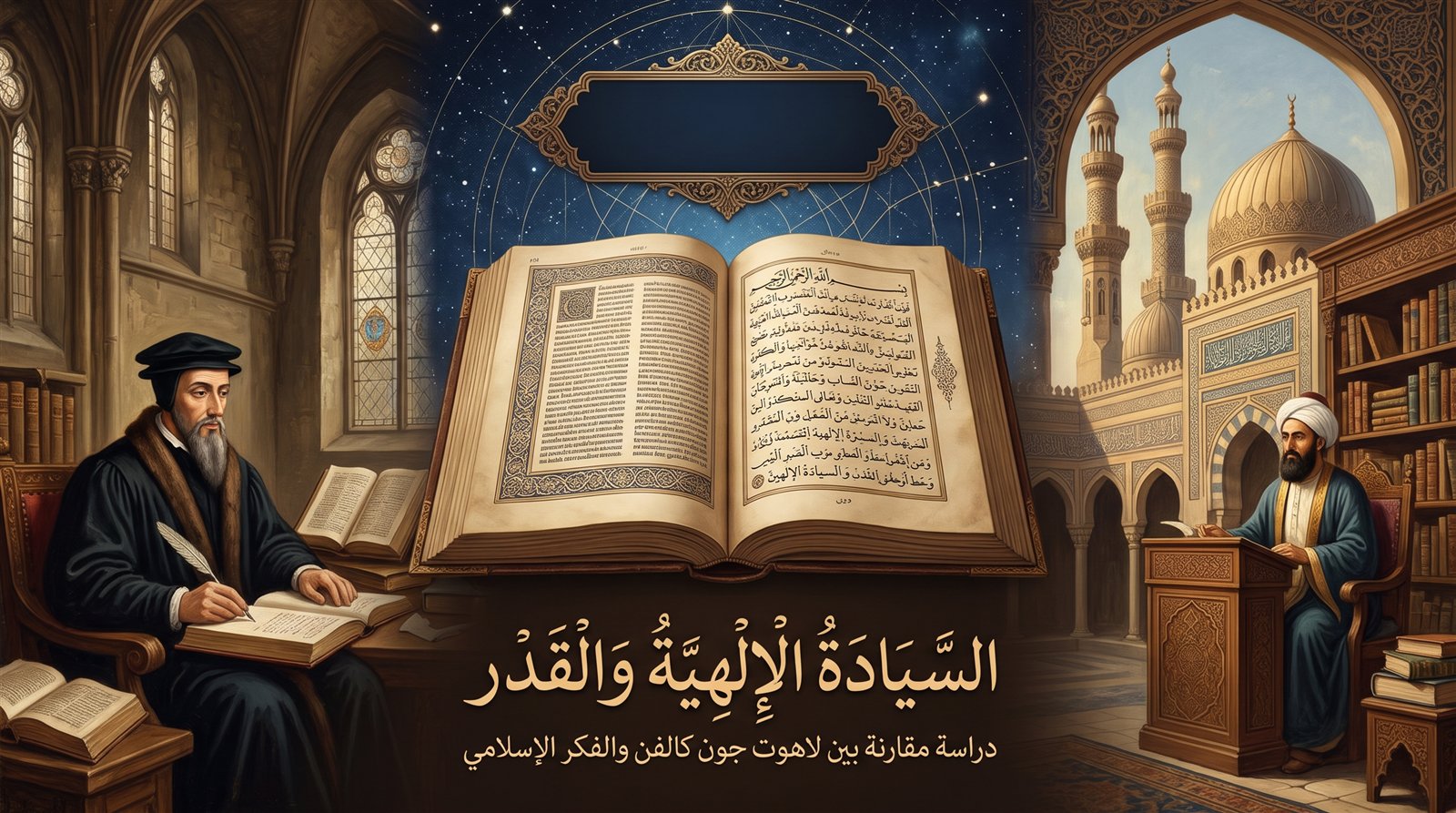
This study examines, through comparative research and analysis, the theological and historical intersections between the thought of the French Protestant reformer John Calvin (1509–1564) and the theological and juristic tradition of Islam. It takes as its point of departure the problem of “absolute divine sovereignty and decree,” understood as the deepest point of contact between Calvinian theology and Sunni kalām (both Ashʿarī and traditionalist), while surveying the foundational textual evidence on both sides. The study then examines the conceptual mechanisms each side devised to reconcile the inevitability of the divine will with human moral responsibility — namely the distinction between the cosmic and the legislative will, the Ashʿarī theory of kasb (acquisition), and the Calvinian doctrine of secondary causes. Finally, it traces the sociological afterlives of this thought in the modern Islamic world: from the sixteenth-century “Turco-Calvinism” controversy, through the Islamic reform movements and Presbyterian missions of the nineteenth century, to the phenomenon of “Islamic Calvinism” and capitalist work ethics in contemporary Anatolia.
I. Introduction: Historical and Methodological Frame
Since the rise of the Protestant Reformation in the sixteenth century, the theology of the French reformer John Calvin has marked a decisive turning point in Western religious and social thought. Despite the temporal and geographical distance between the emergence of Islam in the seventh century and the appearance of Calvinism in Geneva, an academic approach to the relationship between Calvin’s thought and Islam reveals two interlocking levels of inquiry. The first is the structural theological convergence on questions of transcendent monotheism, absolute divine sovereignty, and decree: a convergence so plain that, in the late sixteenth century, Catholic and Lutheran opponents of Calvin were driven to accuse him of importing “Muhammadan fatalism” into Christianity and coined the term “Turco-Calvinism” (Calvino-Turcismus) to describe his doctrine.1 The second is the modern sociological and historical afterlife, in which the Calvinian model was invoked in the nineteenth and twentieth centuries to analyse movements of religious reform in the Islamic world, and to study the rise of a conservative Islamic bourgeoisie and its capitalist work ethic in light of Max Weber’s thesis.2
This paper aims to offer a comparative study grounded in the primary sources of both traditions: to establish the textual and theological evidence on the question of divine sovereignty and decree, to analyse how Calvin and the Muslim theologians each handled the problem of human action, and then to trace the manifestations of “Islamic Protestantism” and “Islamic Calvinism” in contemporary religious and economic life.
II. Absolute Divine Sovereignty: “The Will That Is Not Reversed”
Calvinism and the Sunni schools (Ashʿarī and traditionalist alike) share a single ontological starting point: God is not merely a “first engineer” or a passive observer of the cosmos, but the dominant agent and sustainer, without whose will and direct governance not an atom moves in His kingdom; His will is the first cause of every existent, and no law or authority stands above Him to hold Him to account or to bound His action.
1. Sovereignty and Providence in the Theology of John Calvin
In his foundational work, the Institutes of the Christian Religion — specifically Books I.16–18 — Calvin launches a fierce attack on the philosophers who depict God as an all-knowing creator who leaves the world to run according to general natural laws or independent human choices. Calvin insists that providence is not mere foreknowledge but an “effective and determinate will” that directs every particular event in the world, from the fall of a leaf to the decisions of kings and the destinies of nations.3
Calvin grounds this vision in a set of central biblical witnesses:
- The comprehensiveness of the divine will (Ephesians 1:11): Calvin cites Paul’s statement that God “works all things according to the counsel of His will,” insisting that the divine will is the highest law of existence.
- The potter and the clay (Romans 9:19–21): When the human mind raises the question of accountability — “Why does He still find fault? For who resists His will?” — Calvin brings forward Paul’s decisive answer, grounded in absolute sovereignty: “Who are you, O man, to answer back to God? Will what is formed say to Him who formed it, ‘Why have you made me like this?’ Has the potter no right over the clay, to make from the same lump one vessel for honour and another for dishonour?”4
- The unaccountable authority of God (Daniel 4:35; Isaiah 45:7): Calvin leans on the verse “He does according to His will in the host of heaven and among the inhabitants of the earth; and none can stay His hand or say to Him, ‘What have you done?’”, and on the Isaianic text “I form light and create darkness; I make well-being and create calamity; I am the Lord, who does all these things” — understanding “calamity” as the plagues and providential judgements God sends in His justice.
2. Sovereignty and Absolute Kingship in Islamic Theology
On the Islamic side, this principle is the cornerstone of the creed of Ahl al-Sunna (Ashʿarīs, Māturīdīs, and the people of hadith), in contrast to the Muʿtazilī school, which bounded the cosmic divine will by the laws of “the best and the most fitting” and of rational good and evil.5 Abū al-Ḥasan al-Ashʿarī (d. 324 AH / 936 CE) states in al-Ibāna ʿan uṣūl al-diyāna and al-Lumaʿ fī al-radd ʿalā ahl al-zaygh wa-l-bidaʿ that God is the creator and owner of everything, and that injustice is impossible for Him: for injustice, in language and in law, is disposing of what belongs to another or overstepping a limit set by a higher commander — and God has no owner above Him and no commander who bounds His authority.6
The Qur’anic and hadith witnesses on this point match the logic on which Calvin relied:
- No questioning of the divine self (Qur’an 21:23): “He is not questioned about what He does, but they will be questioned.” This is the cardinal verse for the theologians in establishing that God’s acts are not subject to the judgement of created minds — precisely parallel to the potter argument in Romans 9.
- The efficacy of the absolute will (Qur’an 85:16; 36:82): God describes Himself as “Doer of what He intends,” and His command, when He intends a thing, is that He says to it “Be,” and it is.
- The dependence of the servant’s will on the Lord’s (Qur’an 81:29; 76:30): “And you do not will unless God, the Lord of the worlds, wills,” and “Indeed, this is a reminder; so whoever wills may take a way to his Lord. And you do not will unless God wills. Indeed, God is ever Knowing, Wise.”
- The comprehensive Sunni principle: the well-known formula transmitted from al-Shāfiʿī and the Sunni theologians: “What God wills is, and what He does not will is not” — which settles the impossibility of any event in the cosmos occurring against the divine cosmic will.7
III. Double Predestination versus the Eternal Decree
The comparison reaches its theological peak in the move from general providence to the question of the human being’s final destiny — salvation or perdition, paradise or fire — and whether this was settled in eternity before man was created, or follows merely from God’s prior knowledge of human deeds.
1. The Doctrine of Double Predestination in Calvin
In Book III of the Institutes (chapters 21–24), Calvin formulates his famous doctrine of predestination, defining it as “the eternal decree of God, by which He determined with Himself what He willed to become of every man. For we are not all created in the same condition; but eternal life is foreordained for some, and eternal damnation for others.”8 Calvin does not settle for saying that God chose believers and passed over the rest negatively; he insists on an active “double predestination”: the effective will of God itself sorted the two groups. Calvin himself described this, in Book III.23.7, with the famous Latin phrase decretum horribile — the “dreadful decree” — for the terror of its impact on the human soul.9
Among the most prominent texts on which Calvin built this doctrine:
- Jacob and Esau (Romans 9:11–13, 18): the text states that God separated the two sons of Isaac while they were still in Rebecca’s womb — “though they were not yet born and had done nothing either good or bad, in order that God’s purpose of election might continue, not because of works but because of Him who calls… As it is written, ‘Jacob I loved, but Esau I hated’… So then He has mercy on whomever He wills, and He hardens whomever He wills.”
- The wicked made for the day of judgement (Proverbs 16:4): Calvin cites “The Lord has made everything for its purpose, even the wicked for the day of trouble,” arguing that the perdition of the non-elect belongs within the higher divine purpose of displaying the glory of His justice.
- The exclusive divine drawing (John 6:44, 65): Christ’s words, “No one can come to me unless the Father who sent me draws him,” and “No one can come to me unless it is granted him by the Father.”
2. The Doctrine of Qadar and the Eternal Writing in Islam
In Islamic creed, faith in decree — its good and its evil — is the sixth pillar of faith, and Sunni theologians order it in four inseparable ranks: comprehensive eternal knowledge; the writing in the Preserved Tablet; the effective will; and the creation of the servants’ persons and acts.10 The Qur’anic and hadith witnesses intersect strikingly with the texts Calvin adduced to establish the prior writing of the creatures’ destinies:
- Creation, election, and bringing forth (Qur’an 11:118–119; 7:179): “And if your Lord had willed, He could have made mankind one community; but they will not cease to differ, except those on whom your Lord has bestowed mercy; and for that He created them. And the word of your Lord has been fulfilled: ‘I will surely fill Hell with jinn and men all together.’” And: “And We have certainly created for Hell many of the jinn and mankind.”
- God’s exclusive prerogative of guidance and misguidance (Qur’an 35:8; 28:56): “For indeed, God sends astray whom He wills and guides whom He wills,” and to His Prophet: “Indeed, you do not guide whom you love, but God guides whom He wills, and He is most knowing of the rightly guided.”
- The hadith of the writing of misery and happiness in the womb (agreed upon): what ʿAbdullāh ibn Masʿūd reported in the two Ṣaḥīḥs, that the Prophet ﷺ said: “Each of you is gathered in his mother’s womb for forty days… then the angel is sent and breathes the spirit into him, and is commanded with four words: to write his provision, his term, his deeds, and whether he is wretched or blessed. By Him besides whom there is no god, one of you may act with the deeds of the people of Paradise until there is between him and it but an arm’s length, then the Book overtakes him and he acts with the deeds of the people of the Fire and enters it…”11
- The hadith of the two handfuls and the first covenant (Musnad Aḥmad; Sunan al-Tirmidhī): that God took two handfuls from the offspring of Adam and said to the companions of the right, “These are in Paradise and I do not care,” and to the companions of the left, “These are in the Fire and I do not care”; and in the hadith of Surāqa ibn Mālik: “Act, for each is made easy for what he was created for.”12
- The hadith of Adam and Moses disputing (agreed upon): Moses said to Adam, “You are our father; you disappointed us and brought us out of Paradise,” and Adam replied, “Do you blame me for a matter God decreed for me forty years before He created me?” The Prophet ﷺ said: “So Adam overcame Moses.”13
IV. The Theological Dilemma and Its Comparative Solutions
Both John Calvin and the Muslim theologians faced the same philosophical and moral challenge: if God decreed everything in eternity and created the acts of His servants, how can human obligation, accountability, and punishment stand without attributing injustice or futility to the Creator? What is academically striking is that the conceptual mechanisms Calvin formulated in the sixteenth century to resolve this problem are structurally identical to those the Muslim theologians — above all al-Ashʿarī and Ibn Taymiyyah — had formulated centuries before him.
1. The Twofold Divine Will: Ibn Taymiyyah and John Calvin
To settle the problem — how can God command obedience and forbid sin, and then will the occurrence of sin and decree it? — both Calvinian theology and Islamic theology (especially in Ibn Taymiyyah’s verified formulation) resorted to a precise distinction between two levels or two faces of the divine will:
a) In John Calvin: the secret decretive will versus the revealed preceptive will
In Book I.18.3 of the Institutes, Calvin distinguishes — on the basis of Deuteronomy 29:29, “The secret things belong to the Lord our God, but the things that are revealed belong to us and to our children” — between:
1. The decretive or secret will: God’s comprehensive eternal decree by which He governs everything that actually occurs in existence, including the effective permission of sins for hidden wise ends. This will cannot be resisted or fail.
2. The preceptive or revealed will: the moral law of God revealed in Scripture — the commands and prohibitions — which defines man’s moral duty and the ground of his accountability, even though human beings constantly transgress it.14
b) In Islamic thought: the cosmic decree versus the legislative command
This division is the backbone of the treatises of Shaykh al-Islām Ibn Taymiyyah (d. 728 AH / 1328 CE) and his student Ibn al-Qayyim (d. 751 AH / 1350 CE) in Shifāʾ al-ʿalīl fī masāʾil al-qaḍāʾ wa-l-qadar wa-l-ḥikma wa-l-taʿlīl:15
1. The cosmic, decreed will (irāda kawniyya qadariyya): synonymous with creation and the comprehensive determination of every event. What God wills to be occurs inevitably, whether it is something He loves and is pleased with (the faith of believers) or something He hates and rejects in law (the disbelief of disbelievers, the creation of Iblīs). Its evidence includes: “So whoever God wants to guide, He expands his chest to Islam; and whoever He wants to lead astray, He makes his chest tight and constricted” (Qur’an 6:125).
2. The legislative, religious will (irāda sharʿiyya dīniyya): related to what God loves, is pleased with, and commands His servants to do. What is willed here does not necessarily occur in every obligated person: God may will, legislatively, that the disbeliever believe, yet he does not believe. Its evidence includes: “God intends ease for you and does not intend hardship for you” (Qur’an 2:185), and “He is not pleased with disbelief for His servants” (Qur’an 39:7).
2. Compatibilism in Calvin and the Ashʿarī Theory of Kasb
Calvin and the Sunni theologians alike rejected pure fatalism (represented in Islam by Jahm ibn Ṣafwān, and in ancient philosophy by the Stoics), which reduces man to a feather in the wind with no will at all. Each side formulated a precise theory combining divine creation with human choice:
- Primary and secondary causes in Calvin: Calvin adopts what modern philosophy calls theological compatibilism. God is the “primary cause” that determines the occurrence of the act, but He executes His decree through “secondary causes” — the human will and its inclinations, free of external physical compulsion. Calvin gives the example of Joseph’s brothers in Genesis 50:20 — “You meant evil against me, but God meant it for good” — and of the crucifixion in Acts 2:23 — “This man, delivered up by the determined plan and foreknowledge of God, you crucified and killed by the hands of lawless men.” The historical act is one, but on God’s side it is wise and holy governance, and on the human side a crime springing from evil intent, for which they deserve punishment.16
- The Ashʿarī theory of kasb, and causality in Ibn Taymiyyah: on the basis of “And God created you and what you do” (Qur’an 37:96), al-Ashʿarī, then al-Bāqillānī and al-Ghazālī, formulated the theory of kasb: the human act is created by God in its bringing-forth and sustaining, and “acquired” by the servant through the directing of his intention and will and the matching of his created power to the determined act. Obligation, reward, and punishment therefore attach to the acquisition and the inward intention, not to the creation. Indeed, the school of Ibn Taymiyyah and the Māturīdīs went closer to Calvinian secondary causes, affirming for the servant a real will and an effective power, made by God a cause among created causes through which the act follows, while God remains the creator of both cause and effect.
V. Points of Essential Divergence
Despite this structural symmetry on sovereignty and decree, the doctrinal systems on which each thought rests diverge radically in the foundations of theological anthropology (the nature of man), the meaning of divine justice, and the psychological effect of the doctrine. The following table sets out the main axes of convergence and divergence.
| Axis of comparison | In the theology of John Calvin | In Islamic creed (Ahl al-Sunna) |
|---|---|---|
| 1. Human nature and the anthropological starting point | Grounded in total depravity inherited from Adam’s original sin: man is born spiritually dead and enslaved to sin (Ephesians 2:1), wholly unable to choose good unless irresistible grace renews his heart. | Rejects the inheritance of original sin — “no bearer of burdens bears the burden of another” — and holds that man is born on a sound fiṭra capable of guidance or error: “and We guided him to the two ways.” He possesses a real capacity to choose; God’s causing a sinner’s heart to deviate is usually a punishment for his own prior deviation: “so when they deviated, God caused their hearts to deviate.” |
| 2. The twofold divine will | The distinction between the secret decretive will, encompassing every event, and the revealed preceptive will, containing the commandments (Deuteronomy 29:29). | The distinction between the cosmic decreed will, synonymous with creation and comprehensive determination, and the legislative religious will, synonymous with love, command, and pleasure (Ibn Taymiyyah and Ibn al-Qayyim). |
| 3. Explaining human action | A theory of compatibilism and twofold causality: God is the acting primary cause, and man’s will and inclinations are the secondary causes through which the decree is realised without physical compulsion. | The Ashʿarī theory of kasb (the act created by God and acquired by the servant through his intention), or the affirmation of created effective causes with the traditionalists and the Māturīdīs. |
| 4. Accounting for God’s acts and divine justice | Refuses to ground election or perdition in prior desert; God’s will is itself the standard of justice, and its end is the glory of His mercy in the elect and of His justice in the damned (Romans 9:22–23). | The Ashʿarīs agree with Calvin in not assigning purposes to God’s acts, while the Qur’anic texts and the traditionalist and Māturīdī schools affirm that His decree is always joined to perfect wisdom and justice — “God does not wrong anyone by an atom’s weight” — and that the decree rests on God’s eternal knowledge of the servant’s state. |
| 5. Psychological and eschatological effect | The perseverance of the saints: the elect never lose their salvation. This generated an anxiety that drove Calvinists to strenuous worldly labour in search of the signs of election (certitudo salutis). | The decree is a hidden mystery, and the rule is that deeds are judged by their endings. The Muslim lives in a balance between fear and hope, neither secure from God’s cunning nor despairing of His mercy, while commanded to act and to take the means. |
VI. Historical and Sociological Dimensions: From “Turco-Calvinism” to “Islamic Calvinism”
The comparison between Calvin’s thought and Islam did not stop at the boundaries of theological debate; it became an active historical and sociological force along three major trajectories.
1. The “Turco-Calvinism” Controversy in the Sixteenth Century
In the late sixteenth century — specifically in 1597 — the two English Catholic theologians William Rainolds and William Gifford published a massive Latin volume entitled Calvino-Turcismus: id est, Calvinisticae perfidiae, cum Mahumetana collatio, in which they set out a detailed comparison intended to prove that Calvinism was nothing but a Christian version of Islam.18 This European linking of Calvinists with the Ottomans rested on two pillars:
- Convergence in strict monotheism and iconoclasm: Calvin was the most rigorous of the Protestant reformers in stripping churches of images, statues, and relics and in rejecting the intercession of the saints, considering all of it idolatry that diminished God’s glory — which Catholics and Lutherans saw as identical to the spirit of the mosque in Islam, founded on abstraction and pure monotheism.
- The Ottoman–Protestant geopolitical alliance: common hostility to the Catholic Habsburg Empire and the papacy produced close military, diplomatic, and commercial rapprochement between the Ottoman state and the Calvinists of the Netherlands, Hungary, and France (the Huguenots), to the point that the Dutch Calvinist rebels (the Geuzen) wore their famous slogan on their silver badges: “Better Turkish than papal” (Liever Turks dan Paaps).19
2. Islamic Reform Movements and Presbyterian Missions (19th–20th Centuries)
In the modern era the influence ran in the opposite direction: the nineteenth and twentieth centuries saw direct contact between the Islamic world and Calvinian institutions — represented by the Presbyterian missions in Egypt and the Levant — alongside the rise of movements of Islamic religious reform:
- The thesis of “Islamic Protestantism”: the pioneers of Islamic reform — from Jamāl al-Dīn al-Afghānī, Muḥammad ʿAbduh, and Rashīd Riḍā to the Iranian thinker ʿAlī Sharīʿatī, who explicitly called for an “Islamic Protestantism” — drew on the Protestant reformist model founded on sola scriptura: a direct return to the founding text (Qur’an and Sunna), the breaking of the traditional institution’s monopoly on interpreting religion, the purification of creed from Sufi intermediaries and shrines, and the transformation of the doctrine of decree from passive quietism into a motive for work and civilisational renaissance.20
- Institutional and educational organisation: the schools and universities founded by the Calvinist Presbyterian missions (the Syrian Protestant College / American University of Beirut, Assiut College, and the American University in Cairo) helped transmit modern institutional management, printing, and volunteer work, inspiring Islamic reform movements to establish parallel charitable and educational associations adopting the same organisational efficiency — such as Jamʿiyyat al-Maqāṣid al-Khayriyya, al-Jamʿiyya al-Sharʿiyya, and Jamʿiyyat al-Shubbān al-Muslimīn.21
3. “Islamic Calvinism” and the Capitalist Work Ethic Today
In 1905 the German sociologist Max Weber published his classic The Protestant Ethic and the Spirit of Capitalism, arguing that the Calvinist doctrine of decree produced in its followers what he called “inner-worldly asceticism”: diligent work, the investment of time, and the accumulation of capital joined to personal austerity became a psychological means of demonstrating divine election and serving God’s glory on earth.22
A full century after Weber’s thesis — in 2005 — the European Stability Initiative (ESI) published its well-known field study, Islamic Calvinists: Change and Conservatism in Central Anatolia.23 It observed the rise of a new class of conservative Muslim businessmen and industrialists in the Anatolian cities (Kayseri, Konya, Gaziantep — the so-called “Anatolian tigers” and the Independent Industrialists’ and Businessmen’s Association, MÜSİAD), who embodied the Weberian Calvinist spirit in a purely Islamic context through:
- Work and production as worship and struggle: turning economic success and industrial and commercial excellence into a religious duty that strengthens the Islamic nation and pleases God, so that opening factories and employing workers is seen as no less rewarding than building mosques.
- Moral puritanism and the rationalisation of consumption: a strict combination of full engagement with free-market mechanisms and capitalist globalisation on the one hand, and a firm preservation of Islamic family and religious values and distance from conspicuous luxury consumption on the other.
- Endowments and institutional charity: recycling capitalist profit surpluses into educational endowments, private universities, scholarships, and social solidarity institutions.
VII. Conclusion
This comparative study shows that the relationship between John Calvin’s thought and Islam goes beyond surface resemblances to a deep intersection in the structure of theological and social reasoning. At the doctrinal level, both Calvinian theology and Sunni Islamic theology offered a coherent model for magnifying absolute divine sovereignty and vindicating the divine will from weakness, while devising convergent conceptual tools — the distinction between the cosmic and the legislative will, and the theories of kasb and secondary causes — to protect human moral responsibility. Yet Islamic thought preserved its essential particularity in grounding obligation on the purity of human nature, denying inherited sin, and binding the divine decree to absolute wisdom and justice. At the sociological level, modern Islamic experiments in religious and economic reform have shown that a deep belief in decree and divine sovereignty, once freed from quietist readings, becomes a driving energy for production and construction comparable in its ethical effectiveness to the Protestant ethic that founded Western modernity.
VIII. Notes and References (Chicago Style)
1 William Rainolds and William Gifford, Calvino-Turcismus: id est, Calvinisticae perfidiae, cum Mahumetana collatio (Antwerp: In aedibus Petri Belleri, 1597), 45–82.
2 Max Weber, The Protestant Ethic and the Spirit of Capitalism, trans. Talcott Parsons (London: Routledge, 2001), 53–80.
3 John Calvin, Institutes of the Christian Religion, ed. John T. McNeill, trans. Ford Lewis Battles, vol. 1 (Philadelphia: Westminster Press, 1960), bk. 1, chaps. 16–18, pp. 197–237.
4 The Bible, New Testament, Paul’s Epistle to the Romans, ch. 9, vv. 19–21 (Van Dyck translation).
5 Muḥammad ʿImāra, al-Muʿtazila wa-mushkilat al-ḥurriyya al-insāniyya [The Muʿtazila and the Problem of Human Freedom] (Cairo: Dār al-Shurūq, 1988), 64–79.
6 Abū al-Ḥasan ʿAlī ibn Ismāʿīl al-Ashʿarī, al-Lumaʿ fī al-radd ʿalā ahl al-zaygh wa-l-bidaʿ, ed. Ḥammūda Gharāba (Cairo: Maṭbaʿat Miṣr, 1955), 75–81; and al-Ibāna ʿan uṣūl al-diyāna, ed. Fawqiyya Ḥusayn Maḥmūd (Cairo: Dār al-Anṣār, 1977), 169–178.
7 Abū Jaʿfar Aḥmad ibn Muḥammad al-Ṭaḥāwī, Matn al-ʿAqīda al-Ṭaḥāwiyya, with the commentary of Ibn Abī al-ʿIzz, ed. Shuʿayb al-Arnaʾūṭ and ʿAbd al-Muḥsin al-Turkī (Beirut: Muʾassasat al-Risāla, 1997), 1:112–118.
8 Calvin, Institutes, vol. 2, bk. 3, chap. 21, sec. 5, p. 926.
9 Calvin, Institutes, vol. 2, bk. 3, chap. 23, sec. 7, p. 955.
10 Taqī al-Dīn Aḥmad ibn ʿAbd al-Ḥalīm Ibn Taymiyyah, al-ʿAqīda al-Wāsiṭiyya, ed. Muḥammad Khalīl Harrās (Riyadh: Dār al-Hijra, 1994), 175–182.
11 Muḥammad ibn Ismāʿīl al-Bukhārī, Ṣaḥīḥ al-Bukhārī (Damascus: Dār Ibn Kathīr, 2002), Kitāb Badʾ al-Khalq, hadith no. 3208; and Muslim ibn al-Ḥajjāj, Ṣaḥīḥ Muslim (Riyadh: Dār Ṭayba, 2006), Kitāb al-Qadar, hadith no. 2643.
12 Aḥmad ibn Ḥanbal, Musnad al-Imām Aḥmad ibn Ḥanbal, ed. Shuʿayb al-Arnaʾūṭ et al. (Beirut: Muʾassasat al-Risāla, 2001), 29:193, hadith no. 17660; and al-Tirmidhī, Sunan al-Tirmidhī (Beirut: Dār al-Gharb al-Islāmī, 1996), Abwāb Tafsīr al-Qurʾān, hadith no. 3075.
13 Al-Bukhārī, Ṣaḥīḥ al-Bukhārī, Kitāb al-Qadar, hadith no. 6614; and Muslim, Ṣaḥīḥ Muslim, Kitāb al-Qadar, hadith no. 2652.
14 Calvin, Institutes, vol. 1, bk. 1, chap. 18, sec. 3, pp. 233–235.
15 Shams al-Dīn Muḥammad ibn Abī Bakr Ibn Qayyim al-Jawziyya, Shifāʾ al-ʿalīl fī masāʾil al-qaḍāʾ wa-l-qadar wa-l-ḥikma wa-l-taʿlīl, ed. Muḥammad Badr al-Dīn Abū Firās al-Naʿsānī (Beirut: Dār al-Maʿrifa, 1978), 275–288.
16 Calvin, Institutes, vol. 1, bk. 1, chap. 17, sec. 5, pp. 216–218; Paul Helm, John Calvin’s Ideas (Oxford: Oxford University Press, 2004), 157–183.
17 Abū Ḥāmid Muḥammad ibn Muḥammad al-Ghazālī, al-Iqtiṣād fī al-iʿtiqād, ed. Inṣāf Ramaḍān (Damascus: Dār Qutayba, 2003), 85–94; and Abū Bakr Muḥammad ibn al-Ṭayyib al-Bāqillānī, Tamhīd al-awāʾil wa-talkhīṣ al-dalāʾil, ed. ʿImād al-Dīn Aḥmad Ḥaydar (Beirut: Muʾassasat al-Kutub al-Thaqāfiyya, 1987), 341–352.
18 Benjamin J. Kaplan, Divided by Faith: Religious Conflict and the Practice of Toleration in Early Modern Europe (Cambridge, MA: Belknap Press of Harvard University Press, 2007), 312–318.
19 Christine Isom-Verhaaren, Allies with the Infidel: The Ottoman and French Alliance in the Sixteenth Century (London: I.B. Tauris, 2011), 48–62.
20 Muḥammad ʿAbduh, Risālat al-Tawḥīd, ed. Muḥammad ʿImāra (Cairo: Dār al-Shurūq, 1994), 72–85; and ʿAlī Sharīʿatī, al-ʿAwda ilā al-dhāt [Return to the Self], trans. Ibrāhīm al-Dasūqī Shatā (Cairo: al-Zahrāʾ li-l-Iʿlām al-ʿArabī, 1986), 114–129.
21 Heather J. Sharkey, American Evangelicals in Egypt: Missionary Encounters in an Age of Empire (Princeton, NJ: Princeton University Press, 2008), 96–134.
22 Weber, The Protestant Ethic, 65–78.
23 European Stability Initiative (ESI), Islamic Calvinists: Change and Conservatism in Central Anatolia (Berlin and Istanbul: European Stability Initiative, September 19, 2005), 1–36.
IX. Bibliography (Chicago Manual of Style, 17th ed.)
Arabic sources and references
- Ibn Taymiyyah, Taqī al-Dīn Aḥmad ibn ʿAbd al-Ḥalīm. al-ʿAqīda al-Wāsiṭiyya. Edited by Muḥammad Khalīl Harrās. Riyadh: Dār al-Hijra li-l-Nashr wa-l-Tawzīʿ, 1994.
- Ibn Taymiyyah, Taqī al-Dīn Aḥmad ibn ʿAbd al-Ḥalīm. Majmūʿ al-Fatāwā (vol. 8: al-Qadar). Compiled by ʿAbd al-Raḥmān ibn Muḥammad ibn Qāsim. Medina: Majmaʿ al-Malik Fahd li-Ṭibāʿat al-Muṣḥaf al-Sharīf, 1995.
- Ibn Ḥanbal, Aḥmad. Musnad al-Imām Aḥmad ibn Ḥanbal. Edited by Shuʿayb al-Arnaʾūṭ et al. 50 vols. Beirut: Muʾassasat al-Risāla, 2001.
- Ibn Qayyim al-Jawziyya, Shams al-Dīn Muḥammad ibn Abī Bakr. Shifāʾ al-ʿalīl fī masāʾil al-qaḍāʾ wa-l-qadar wa-l-ḥikma wa-l-taʿlīl. Edited by Muḥammad Badr al-Dīn Abū Firās al-Naʿsānī. Beirut: Dār al-Maʿrifa, 1978.
- Al-Ashʿarī, Abū al-Ḥasan ʿAlī ibn Ismāʿīl. al-Ibāna ʿan uṣūl al-diyāna. Edited by Fawqiyya Ḥusayn Maḥmūd. Cairo: Dār al-Anṣār, 1977.
- Al-Ashʿarī, Abū al-Ḥasan ʿAlī ibn Ismāʿīl. al-Lumaʿ fī al-radd ʿalā ahl al-zaygh wa-l-bidaʿ. Edited by Ḥammūda Gharāba. Cairo: Maṭbaʿat Miṣr, 1955.
- Al-Bāqillānī, Abū Bakr Muḥammad ibn al-Ṭayyib. Tamhīd al-awāʾil wa-talkhīṣ al-dalāʾil. Edited by ʿImād al-Dīn Aḥmad Ḥaydar. Beirut: Muʾassasat al-Kutub al-Thaqāfiyya, 1987.
- Al-Bukhārī, Muḥammad ibn Ismāʿīl. Ṣaḥīḥ al-Bukhārī. Damascus and Beirut: Dār Ibn Kathīr, 2002.
- Al-Tirmidhī, Muḥammad ibn ʿĪsā. Sunan al-Tirmidhī (al-Jāmiʿ al-Kabīr). Edited by Bashshār ʿAwwād Maʿrūf. Beirut: Dār al-Gharb al-Islāmī, 1996.
- Sharīʿatī, ʿAlī. al-ʿAwda ilā al-dhāt [Return to the Self]. Translated by Ibrāhīm al-Dasūqī Shatā. Cairo: al-Zahrāʾ li-l-Iʿlām al-ʿArabī, 1986.
- Al-Ṭaḥāwī, Abū Jaʿfar Aḥmad ibn Muḥammad. Sharḥ al-ʿAqīda al-Ṭaḥāwiyya by Ibn Abī al-ʿIzz al-Ḥanafī. Edited by Shuʿayb al-Arnaʾūṭ and ʿAbd al-Muḥsin al-Turkī. Beirut: Muʾassasat al-Risāla, 1997.
- ʿAbduh, Muḥammad. Risālat al-Tawḥīd. Edited by Muḥammad ʿImāra. Cairo: Dār al-Shurūq, 1994.
- ʿImāra, Muḥammad. al-Muʿtazila wa-mushkilat al-ḥurriyya al-insāniyya [The Muʿtazila and the Problem of Human Freedom]. Cairo: Dār al-Shurūq, 1988.
- Al-Ghazālī, Abū Ḥāmid Muḥammad ibn Muḥammad. al-Iqtiṣād fī al-iʿtiqād. Edited by Inṣāf Ramaḍān. Damascus: Dār Qutayba, 2003.
- Muslim ibn al-Ḥajjāj, Abū al-Ḥusayn al-Qushayrī. Ṣaḥīḥ Muslim. Edited by Naẓar Muḥammad al-Fāryābī. Riyadh: Dār Ṭayba, 2006.
Foreign references
- Calvin, John. Institutes of the Christian Religion. Edited by John T. McNeill. Translated by Ford Lewis Battles. 2 vols. Library of Christian Classics, vols. 20–21. Philadelphia: Westminster Press, 1960.
- European Stability Initiative (ESI). Islamic Calvinists: Change and Conservatism in Central Anatolia. Berlin and Istanbul: European Stability Initiative, September 19, 2005.
- Helm, Paul. John Calvin’s Ideas. Oxford: Oxford University Press, 2004.
- Isom-Verhaaren, Christine. Allies with the Infidel: The Ottoman and French Alliance in the Sixteenth Century. London: I.B. Tauris, 2011.
- Kaplan, Benjamin J. Divided by Faith: Religious Conflict and the Practice of Toleration in Early Modern Europe. Cambridge, MA: Belknap Press of Harvard University Press, 2007.
- Rainolds, William, and William Gifford. Calvino-Turcismus: id est, Calvinisticae perfidiae, cum Mahumetana collatio. Antwerp: In aedibus Petri Belleri, 1597.
- Sharkey, Heather J. American Evangelicals in Egypt: Missionary Encounters in an Age of Empire. Princeton, NJ: Princeton University Press, 2008.
- Weber, Max. The Protestant Ethic and the Spirit of Capitalism. Translated by Talcott Parsons. London: Routledge, 2001.